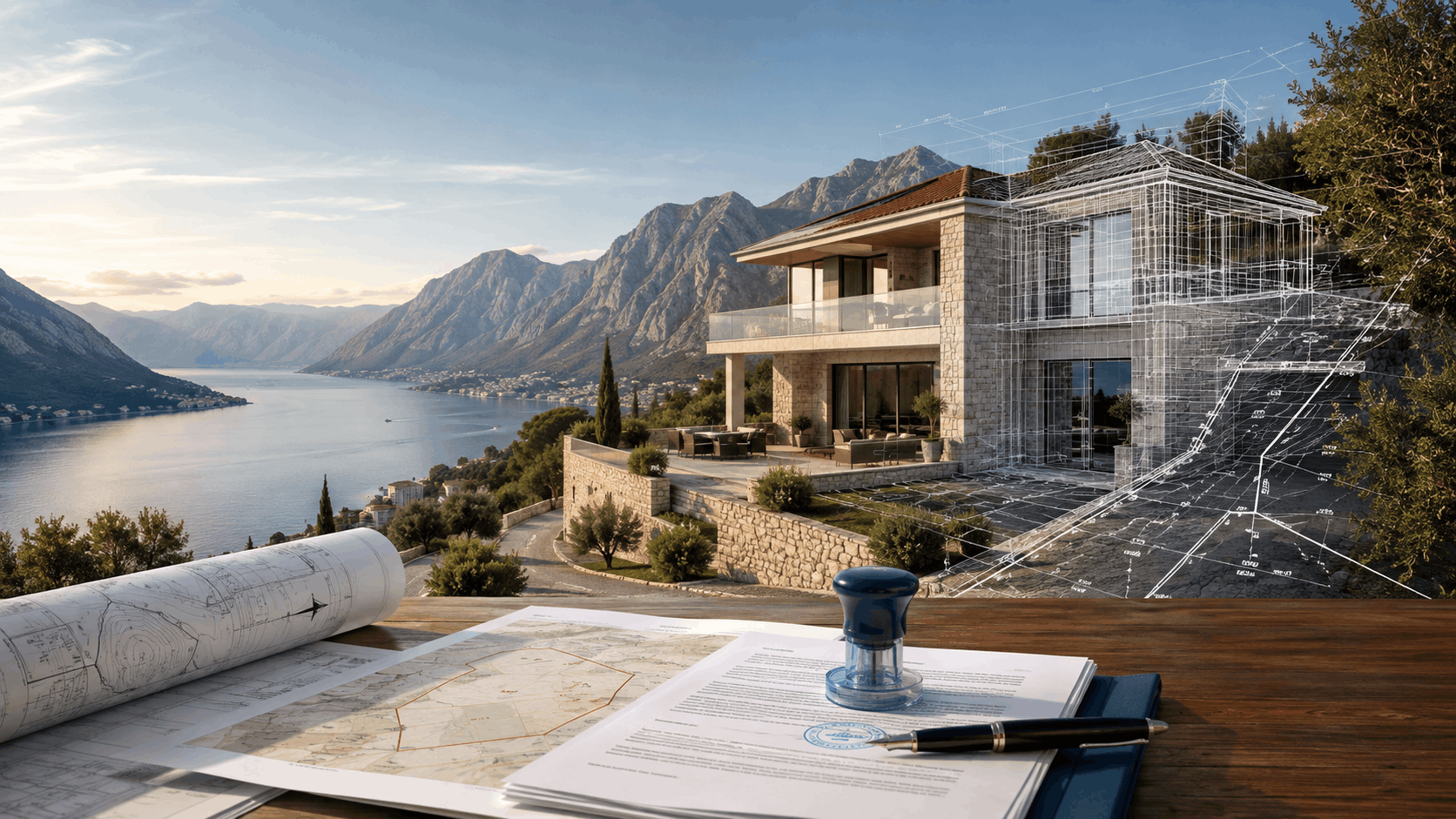
What counts as an unregistered ("illegal") building
Montenegrin law treats a building as illegal (bespravni objekat) if it was built, extended, or altered without a building permit, or in a way that doesn't match the permit that was issued. This is extremely common on the coast: older family houses expanded over decades, apartment blocks with an extra floor added after approval, or entire villas built ahead of formal paperwork to save time.
The law changed in 2025–2026 — and the deadline is real
Montenegro adopted a new Law on the Legalization of Illegal Buildings (Official Gazette No. 91/2025), in force since August 2025, with amendments passed in February 2026. Two details matter most for buyers right now:
- The cut-off is a satellite snapshot. Only buildings that existed on the satellite imagery taken around 27 July 2025 are eligible for legalization at all. Anything built after that date is not being grandfathered in — it faces removal.
- The filing window has been extended to 20 September 2026 for owners to submit their initial survey and documentation. After that, cadastre is required to register a formal restriction (zabilježba zabrane otuđenja) blocking sale or transfer of properties that missed the deadline.
In other words: this isn't a vague, permanently-tolerated grey zone anymore. It's a closing window with a hard administrative consequence attached.
Why this matters when you buy
- No standard sale is possible. A property that hasn't completed legalization cannot be transferred through a normal notarial deed of sale — the notary will refuse.
- Financing is effectively off the table. Montenegrin and foreign banks will not issue a mortgage against a building without clean cadastre registration.
- Resale risk transfers to you. If you buy now and legalization stalls or is refused, you inherit the same problem when you try to sell.
- Demolition is a real outcome, not just a theoretical one, for anything outside the satellite cut-off or refused on public-interest grounds.
The workaround the market actually uses
Because a standard sale isn't possible for a property still in legalization, transactions are structured differently: a loan agreement (ugovor o zajmu) combined with a lawyer-certified preliminary contract (predugovor). This gives the buyer a documented, enforceable claim to future ownership and lets money change hands legally — but it is not the same as registered title. You are holding a strong contractual position, not a deed. The final transfer still depends on legalization actually completing.
What to check before you commit
- Pull the cadastre extract (list nepokretnosti) yourself — don't rely on the seller's copy.
- Confirm whether a legalization request has actually been filed, and its current status with the local municipality.
- Check the construction date against the July 2025 satellite cut-off. This alone can decide whether legalization is even possible.
- Use your own independent lawyer to review the preliminary contract — not one supplied by the seller or developer.
- Don't treat verbal assurances as documentation. "It will be legalized soon" is not a legal status.
The bottom line
A discounted, not-yet-legalized property can be a legitimate opportunity — developers and owners use this structure constantly, and plenty of these deals close successfully. But the discount exists because the risk is real, not because someone is being generous. Know exactly which stage the legalization is at before you decide whether the price justifies the risk.
Looking at a specific listing and want the legalization status checked before you commit? Contact ADRIOM / Adriatic Homes — we work with these structures daily and can tell you where a property actually stands.
ADRIOM DOO | Zubački put b.b., Beljiši, Bar, Montenegro
adriom.me | adriatichomes.me | info@adriom.me | +382 68 752 559